
History · Culture
Historical Connections Between Traditional Korean Brewing Culture and Japanese Sake
The other day, I came across a passage in a book about the history of exchanges between traditional Korean brewing culture and Japanese sake. I found it fascinating. I suppose many people are curious about the drinking cultures of Korea and Japan, so I thought I would put this story together and share it here.
Japan's oldest historical chronicle, the Kojiki (古事記), tells of a brewer from Baekje named Inbeon (인번, 仁番). Inbeon was also known as Susukori (ススコリ). He brewed a drink and presented it to Emperor Ōjin. The emperor was so delighted after drinking it that he composed a song: “The drink brewed by Susukori has made me drunk; the drink that frees me from care and fills me with laughter has made me drunk.”
Completed in 712 CE, the Kojiki is Japan's oldest surviving historical chronicle. It begins with the creation of heaven and earth in Japanese mythology and continues through the reign of Empress Suiko in the early seventh century. The text describes Inbeon, or Susukori, as someone who came from overseas. The Japanese term torai (渡来) refers to crossing the sea to Japan. In historical Japanese records, it often describes people who migrated from the Korean Peninsula or mainland China. The Kojiki does not explicitly state where Susukori came from. However, because his story appears among a series of accounts from Emperor Ōjin's reign involving Baekje and other arrivals from overseas, later generations have generally associated him with the brewing culture of the Korean Peninsula, particularly Baekje.
Japan's ancient historical chronicles portray Emperor Ōjin's reign as a period of frequent contact between Japan and the Korean Peninsula. People arriving from places such as Baekje and Silla brought different technologies and cultural practices to Japan. This is the setting for the story of Susukori presenting his brew to the emperor.
In the same account that mentions Susukori, the Kojiki also refers to another group of arrivals as “the ancestors of the Hata no Miyatsuko” (秦造之祖), the forebears of what would become Japan's Hata clan. The Hata clan was active in the Kyoto area, working in agriculture, water management, textiles, and other industries.
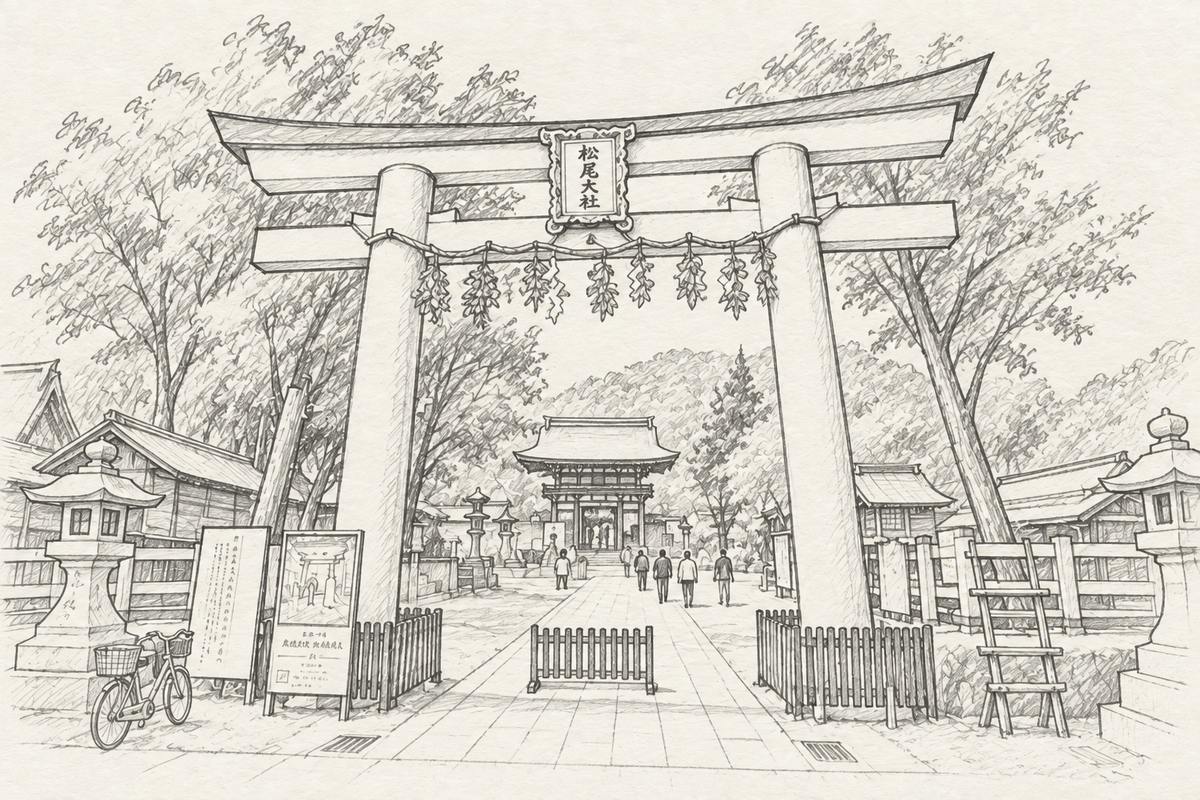
Interestingly, brewing is also considered one of the clan's areas of expertise. In 701 CE, a member of the clan, Hata no Imiki Tori (秦忌寸都理), established a shrine at the foot of Mount Matsuo that became today's Matsunoo Taisha (松尾大社). Matsuo Ōkami, the deity worshipped there, later came to be revered as an ancestral deity of brewing.
The stories above come from a book I’ve been reading recently, 젊은 베르테르의 술품, by Myung Wook (명욱). I would render its title in English as Young Werther’s Drinking Sorrows, an editorial translation of its wordplay on “sorrows” and “술” (sool, or alcoholic drinks).
Recipes may be lost, yet culture is passed down from generation to generation.
We often think of each country's culture as something that developed independently, and it is easy to think that “Japanese sake is Japanese sake, and Korean sool is Korean sool.”
Yet cultural exchanges between the two countries began more than a thousand years ago, and they continue to influence each other today. I hope this little piece of history makes your next drink a little more interesting.